


TB-Seq

- 8hp
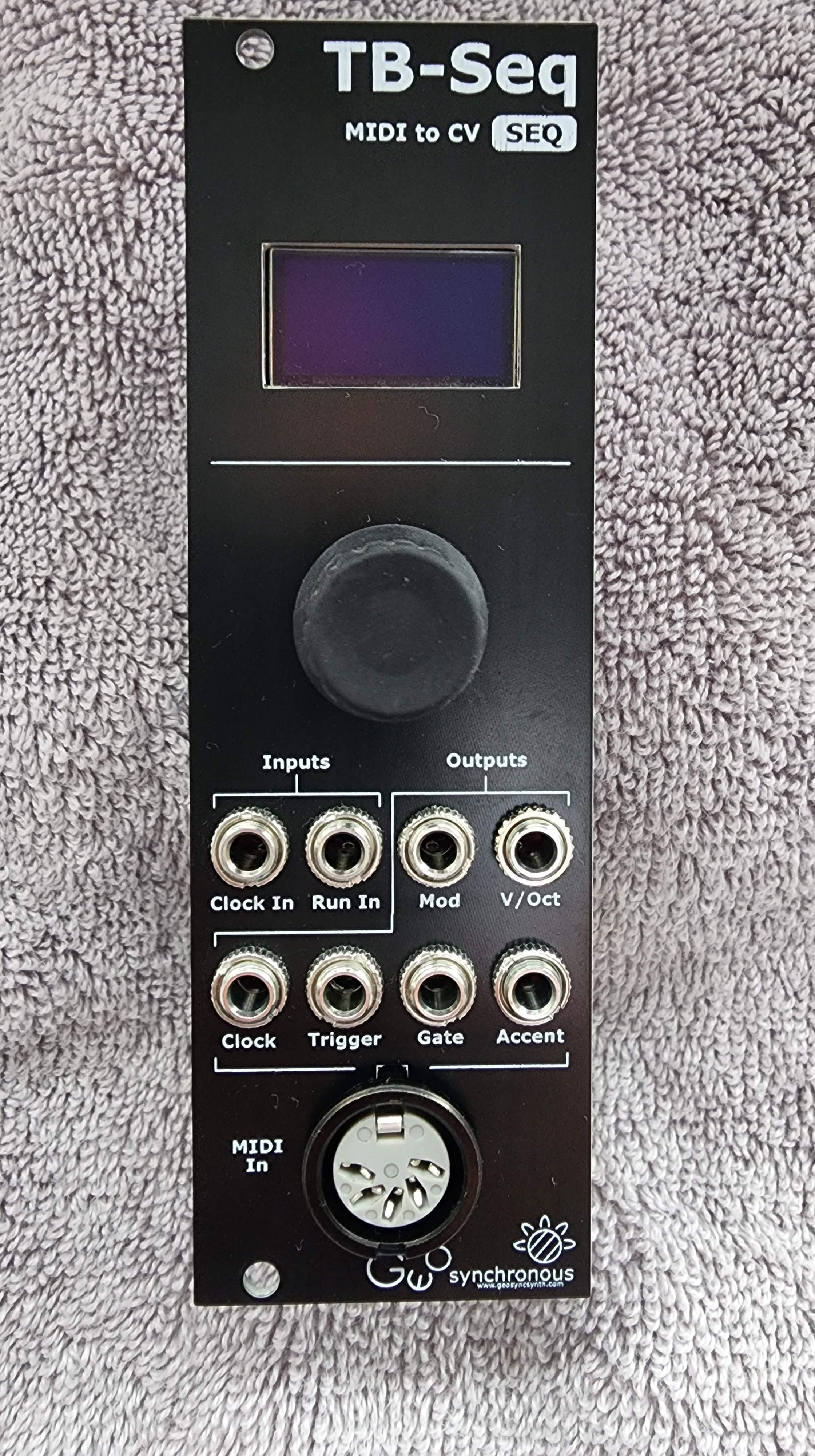
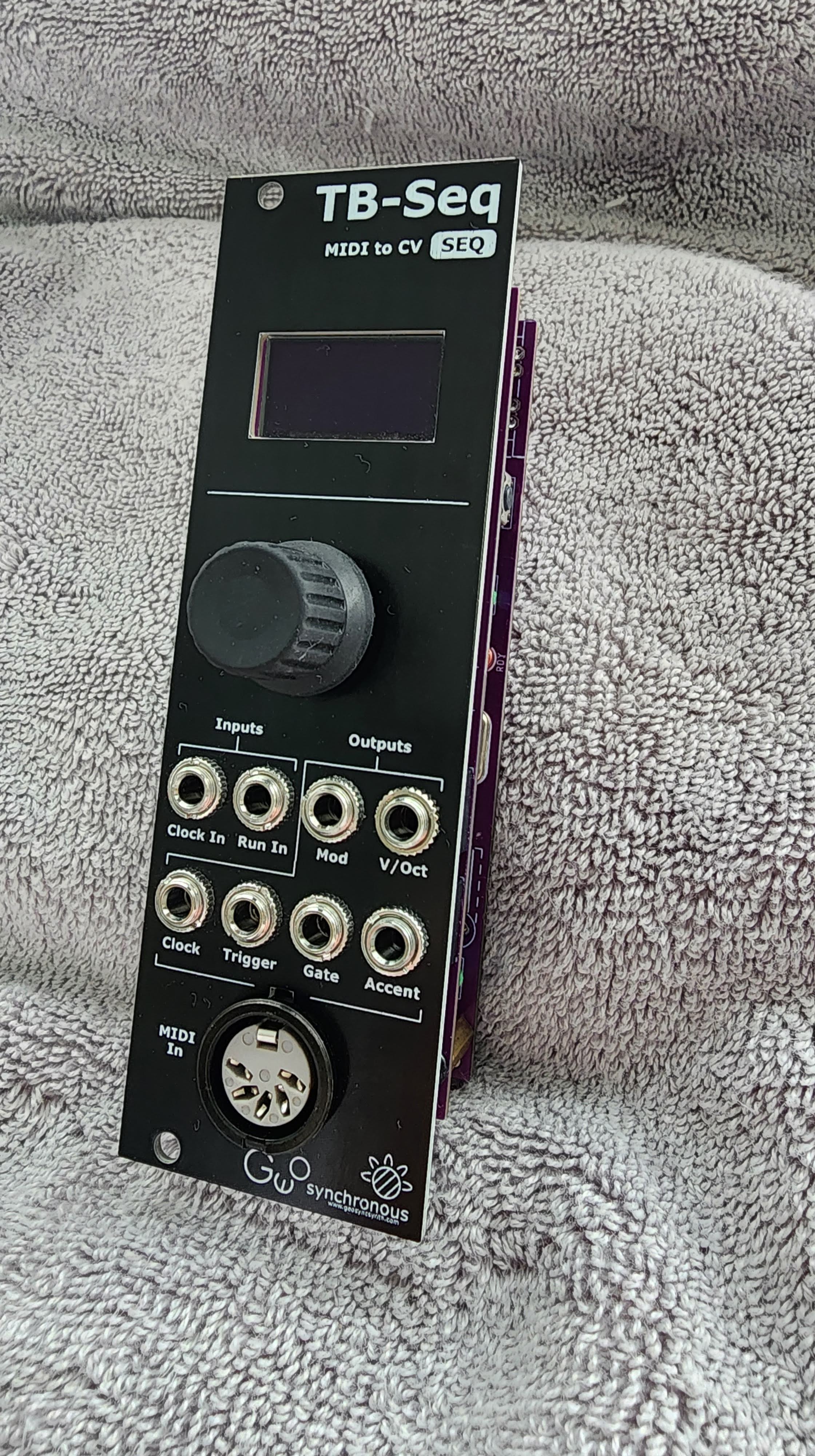
- CV Inputs: Clock In, Run In
- CV Outputs: V/Oct, Modulation, Clock, Trigger, Gate, Accent
- Encoder and settings menu in display.
Module News: 5th Dec 2023 – New firmware available
The TB-Seq Eurorack module and integrated MIDI interface in the Ge0synchronous desktop semi-modular synthesisers combine standard MIDI note to CV V/Oct, gate and trigger conversion as well as MIDI to CV clock with configurable PPQN (pulse per quarter note) – both in and out.
The module also provides a basic “TB” style 1 to 16 step, sixteenth note, sequencer with eight persistent memory slots.
Partnering the module itself is a Windows or Mac based application that can be used to create, save and upload sequences to the sequencer memory slots. The application also allows device settings to be sent to the module. Data transfer between the host computer and module is by means of MIDI SysEx messages via the 5-pin DIN MIDI Input.
Feature List :
- 5 pin DIN MIDI Input.
- CV Input for CV Clock input pulses and CV Run to start sequencer. (Incoming clock configurable PPQN from 1 to 24)
- CV Output for MIDI to CV Clock (configurable PPQN from 4 to 24)
- CV Output for gate, trigger and accent. Gate and trigger correspond to incoming
- MIDI note or sequencer steps.
- CV Output for modulation – value set via configurable MIDI CC.
- 8x 1 to 16 step sequencer slots
- Integrated display and menu to configure device settings, and activate, copy or clear sequencer slots.
- Standalone PC based application to create, save and upload sequences and device settings via MIDI SysEx messages.
- MIDI SysEx firmware updates – continual feature additions coming!
Initially the module began life as a simple MIDI to CV convertor, yeah another one! But quickly evolved into not only allowing MIDI clock to CV clock, but divisions of the MIDI clock. The MIDI receive channel can be set, or left as OMNI, and those MIDI notes are converted to V/Oct CV, with trigger and gate pulses (5v).
Part of the fun of the TB-303 was the sequencer, yes a little strange to input notes and timing independently, but the slide and accent function is key to that sound. So here we have brought the sequencer up to date with a modern 16 step based sequencer, where you can input the notes, and then length on the same step!
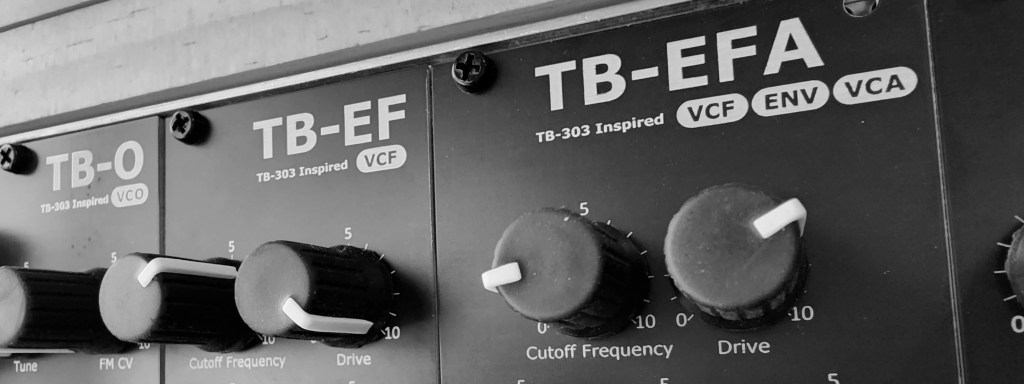
The accent and slide can be configured per step also, and this means the TB-EFA has a great source for accent triggers, as well as the TB-O for note sequences!
Slide, well lets tweak that too – configurable within sub-steps of a note, so the slide can last the whole note, or a subset of that note, gives some nice portamento style effects.
Hugely Configurable Clocking Options
Why not take a CV input clock and use that too, both the MIDI clock and CV clock inputs can be sub-divided, where possible to setup custom PPQN (pulses per quarter note) – this means the internal sequencer can be triggered not just on the normal 6 pulse MIDI input, but more or less… you choose, all configurable either via the settings menu on the device, or via the Sequence Editor external application.
The CV input in particular can be used on any trigger in, so you want to advance the sequence on every trigger, then go for it, this can lead to some interesting variations, particular with slewed, random triggers!
Companion Ge0sync Sequence Editor Application
The module is programmed via the companion application. Note Rather than force you to painfully program the sequence notes, and step information via the tiny screen, we decided that an external application was the best option. This means you must have a Windows or Mac OS based machine to install the app, and with MIDI output. All messages between the PC and the module are via MIDI 5-pin DIN SysEx. A standard audio device with USB into the PC and MIDI 5 pin DIN output is fine – even a MIDI keyboard with connectivity to the PC as a standard MIDI interface will work just fine – but please do note this is REQUIRED to upload custom sequences.

- Set the MIDI output device on the PC
- The overall settings for clocking, MIDI channels, note priority etc etc (these are replicated in the module menus)
- The sequence step programming section. Sequences less than 16 steps can be set.
- Send or activate sequences on the device – the device stores up to 8 sequences in memory, only one of which is “active” at a time.
- Save/local sequences locally to the PC for later recall.
If you loved the TB-O and TB-EFx modules, this is a must have complement to them, along with the TB-FX (details soon!) this completes your 303 in Eurorack.
A full users guide is available on the Documentation page – with links to the firmware, application downloads and more.
The TB-Seq is available as a panel and pcb set, a panel and pcb set with partial kit and in limited numbers as a pre-built, tested and calibrated module.
PCB & Panel
For those happy to source all parts.
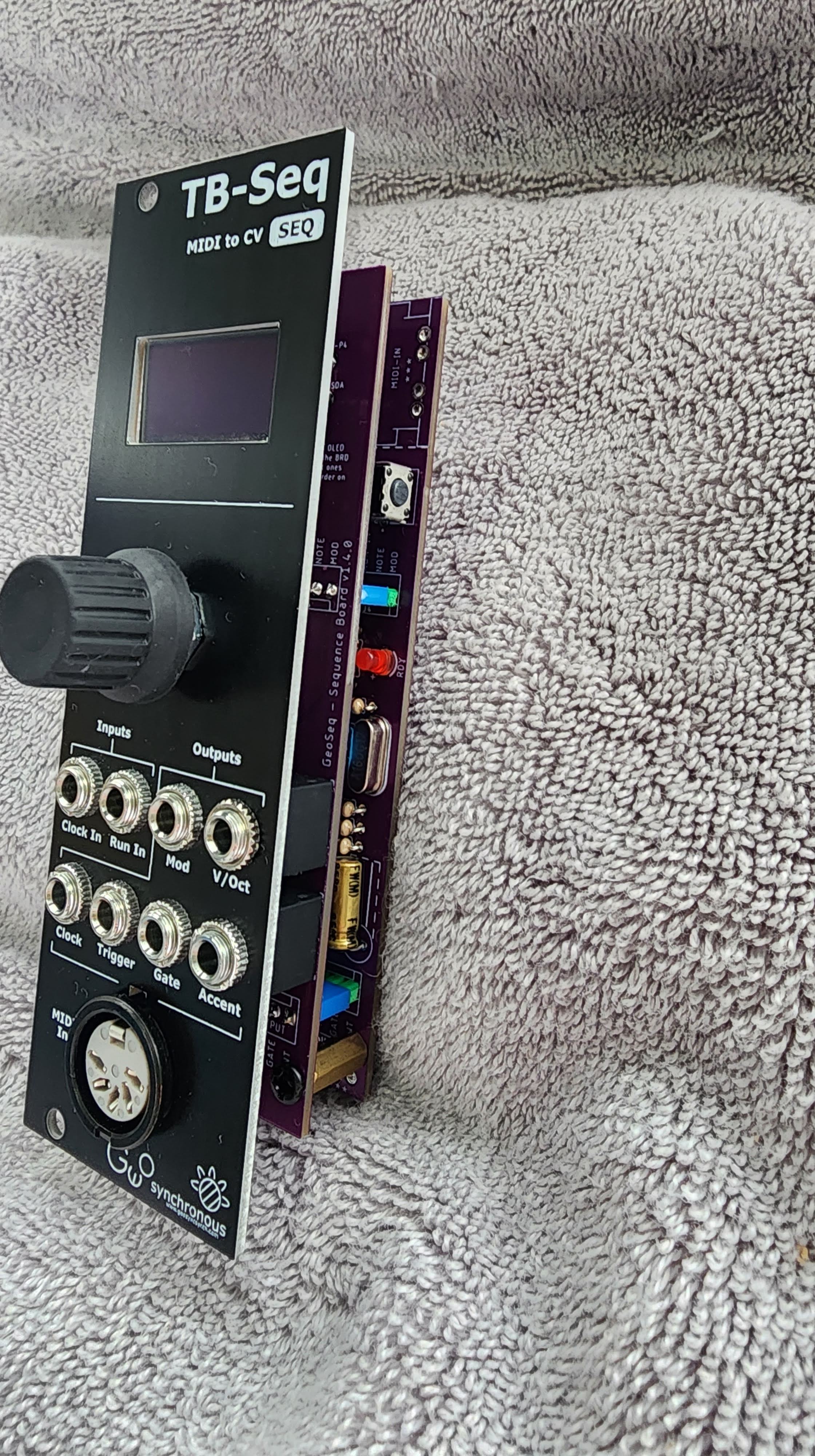
- Voice and Control PCBs
- Black panel
- Contact us for details
Partial Kit
PCB & Panel and includes “rare” parts.
- As PCB & Panel
- Includes (Green items in BOM)
- Programmed Atmega CPU
- Encoder
- OLED Display & Hdr
- Available from synthesizer.nz
Fully Built
Built and Calibrated
- Limited supply
- Fully built, tested and calibrated module using quality components and NOS rare parts.
- PRICES ARE IN NZD!
- Shipping August 2023


Ge0synchronous Synth
 Ge0sync Synth